Evergreen · Tested and kept up to date
Yaris IV / Yaris Cross – a compendium on 12 V battery problems
Contents
Please note
The information collected here is a body of knowledge gathered from available materials, forums and online groups. The measurements and claims come from hobbyists investigating the problems in their own cars. They are not, and do not represent, Toyota’s official position. I also take no responsibility for the advice given here: any work on your own car is at your own risk. If you lack the knowledge or experience, for example to replace a battery, leave it to professionals (not necessarily an authorised Toyota service centre). The article contains affiliate links – if you choose to use them, I may receive a small commission. The shop links lead to Allegro, a Polish marketplace. Thank you!
Update, 2 February 2026
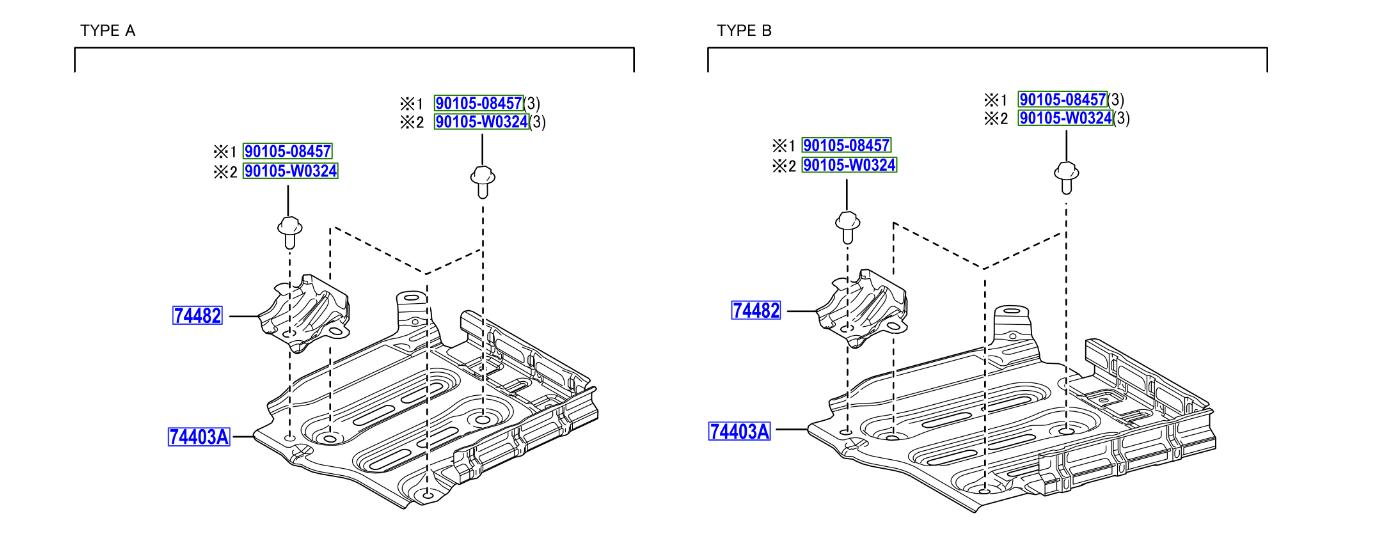
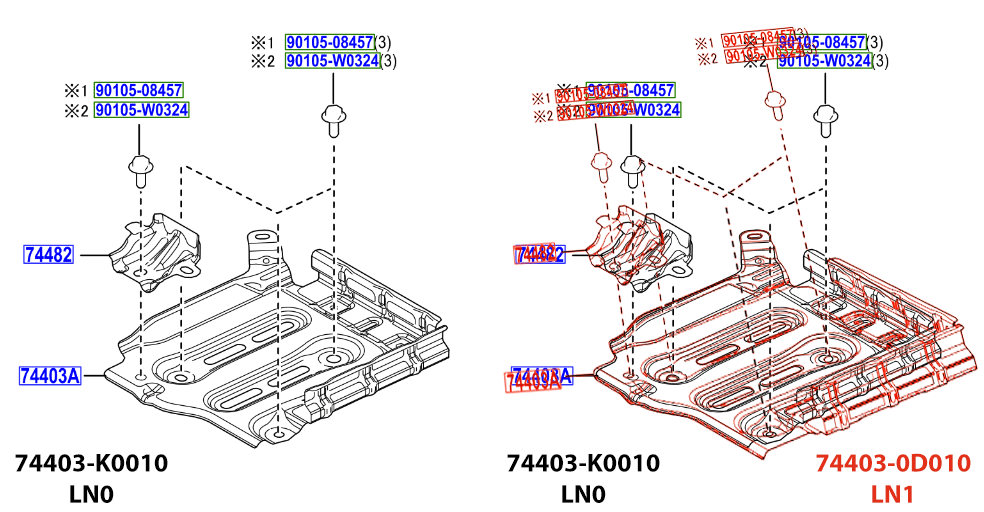
In cars built from 10/2025, Toyota fits an enlarged mount that takes an LN1-size battery. Before you buy, check your car’s production date so you choose the right battery. The drawing shows Type A (old, LN0) and Type B (new, LN1).
Update, 12 March 2026
We now have confirmation that LN1-size batteries, i.e. 207×175×190 mm (W × L × H), also fit plug-and-play in cars built before 10/2025, provided you:
- Replace the base with a larger one (part number 74403-0D010, about 420 PLN at an authorised service centre)
- Modify the original base by removing the metal tab on the HV battery side to make room for the 3 cm longer LN1 battery
Toyota may treat either option (especially b) as grounds for refusing a warranty claim, unlike the “safe option” of fitting an LN0-size battery.
Typical symptoms of battery problems
- The car doesn’t respond to the remote / won’t unlock
- The central locking opens, but everything goes dark when you turn the key / press the Start button
- The app shows a “low starter battery charge” message
- The instrument cluster shows a hybrid system error
- The instrument cluster shows a “low braking force” message
- The instrument cluster shows a low starter battery voltage message
- The car won’t start after a few days parked, even though it starts perfectly when driven every day
Checking
The simplest way to check the voltage is to measure it with a basic multimeter (how-to on YouTube).
A basic multimeter I recommend: UNI-T UT33C.
Alternatively, you can get a voltmeter that plugs into the power socket, such as this one.
You can measure the voltage:
- Between the jump-start terminal in the fuse box under the bonnet on the right (as in this photo) and an unpainted bolt screwed into the car’s body in the engine bay
- Directly on the battery, after removing the cover under the rear seat on the passenger side (photo)

If the voltage is at least 12 V, look for the cause elsewhere (for example a flat battery in a BLE42 security device or a Cobra alarm, another anti-theft device, a blown fuse, etc.).
A voltage below 12 V points to a possible problem with the battery.
About 10.8 V is the minimum voltage that still lets the car start.
Causes
The problems above are most often caused by low voltage and/or low capacity of the 12 V battery. It is a conventional lead-acid battery that sits next to the high-voltage (HV) lithium-ion traction battery under the rear seat, inside the cabin. It powers the car’s systems while the HV battery is not connected (that is, communication with the car over the internet – the app, keyless entry, alarm/immobiliser, the central locking radio receiver – and the car’s lights).
So why does the 12 V battery go flat? Here are the possible causes:
- The car has been left unused for a long time
- The car only does very short trips
- One of the factory systems doesn’t go to sleep (e.g. the DCM communication module, the keyless module)
- One of the added systems doesn’t go to sleep or draws too much current (e.g. an alarm, an extra immobiliser/anti-theft device, a marten repeller, a dashcam with parking mode)
- The battery has lost capacity from being kept permanently undercharged
- The battery has a manufacturing defect
- The battery cannot charge properly because of Toyota’s specific charging algorithm, which aims for a 60–70% state of charge (SoC) rather than 100% SoC.
- The battery’s capacity doesn’t match how we use the car (parked for more than 2 weeks, very short trips)
Solutions
To choose the right solution, first of all identify the cause of the problem.
Still, we may want a safety net in case the situation catches us out and we have no other car, no taxi and no time to wait for roadside assistance.
For such emergencies it’s worth getting a booster – a device for jump-starting a car. There are plenty of models on the market; the most important feature is forced start, which skips the check for a correct connection. It is usually called a “boost” function or “forced start mode”. The Yaris battery, especially after a long stay, can drain to very low voltages, around 3–4 V. Many devices without a forced start mode will refuse to supply power and won’t start the car! So when you buy one, make sure this feature is there and works.
Recommended boosters with forced start:
How to use a booster, shown on a Yaris Cross: video on YouTube.
Remember, though: a booster is a stopgap emergency device, not a fix for the problem.
Usage profile: short, occasional trips, long stays parked, pottering around town (causes: a, b, e, g, h)
Unfortunately, a combination of Toyota’s design decisions makes the fourth-generation hybrid Yaris poorly suited to being a car that is driven rarely or only over short distances.
Leaving the economics aside (the higher price of the hybrid compared with a pure petrol car pays back in fuel savings only after 100,000 km – for someone driving 5,000 km a year that takes 20 years!), the magic fuel consumption below 4 litres per 100 km only appears after a few kilometres, once the combustion engine has warmed up to operating temperature. Before that, electric mode rarely kicks in.
Sometimes, though, life has other plans: our Yaris faces a long stay parked, or we only drive short trips. So what can we do?
Fitting a bigger battery
First, consider whether fitting a higher-capacity battery would solve the problem. From the factory (and as a warranty replacement) Toyota fits 35 Ah batteries (45 Ah in cars built from 10/2025). This follows from the low cranking power the combustion engine needs in a hybrid (the engine is started by the HV battery). Starting a hybrid means closing the HV battery contactors, which starts the converter that generates the 12 V supply. That takes only a few percent of the power a conventional car’s starter motor needs. Unfortunately, cranking current isn’t everything – like most modern cars, the Yaris IV draws much more current while parked than similar designs from 10 or 20 years ago. So capacity (measured in Ah, ampere-hours) matters far more than cold cranking current, CCA (measured in A, amperes).
On top of that comes gradual capacity loss. It is a natural process caused by wear in use. Draining the battery below a certain threshold can speed it up, though. The battery in our Yaris – if it is the factory one – may have lost capacity while the car was still on the dealer’s lot. Why? From the moment it leaves the factory, a car spends a lot of time simply standing. The manufacturer anticipated this and fitted a special fuse that cuts the power without removing the battery, but the fuse is put back so the car can be driven onto a transporter and then off it onto the dealer’s lot. The car gets a pre-delivery inspection, during which it is again driven for a few minutes in stretches of a few dozen metres.
Will the dealer fully charge the battery if it goes flat? No, they will probably just use a booster – anything to get the car started. All this means the battery may lose a good part of its rated capacity before the car is even handed over to the customer.
In addition, until about 2024 the batteries for the hybrid Yaris were supplied by a Turkish manufacturer, Mutlu. The product was certainly attractively priced, but proved very short-lived. Mutlu batteries can lose as much as ⅓ of their rated capacity every (!) time they are run flat.
It doesn’t help that the battery is fitted under the rear seat on the passenger side. The mount only takes batteries of size 175×175×190 (LN0), or in cars built from 10/2025 also 207×175×190 (longer, LN1).
Fortunately, you can buy a battery of this size with a higher capacity than the factory one. Recommended, proven LN0-size batteries:
You can replace it yourself (video link) or have any mechanic do it. The replacement is the same as in any car – there is quite little room, though, and it is not as convenient as replacing a battery in the engine bay. The hybrid drive makes no difference.
If the car is still under warranty, in my opinion it is worth demanding a warranty replacement. Details: post in a Facebook group.
Parking in a garage or on a closed driveway – with a socket
If we can, it is worth considering regularly connecting a charger and topping up the battery.
For occasional charging, any modern car battery charger will do. They regularly turn up in discount supermarkets, but if you’re after something more upmarket, the CTEK MXS 5.0 gets good reviews.
If, on the other hand, we want to leave the car on the charger for longer and our budget is limited, or we don’t want to spend almost 300 PLN on a CTEK, a Motopower maintenance charger can be a decent option.
Chargers like these can be connected in two ways. The most basic is to clip the crocodile clips onto the jump-start point in the fuse box, as described in the owner’s manual:
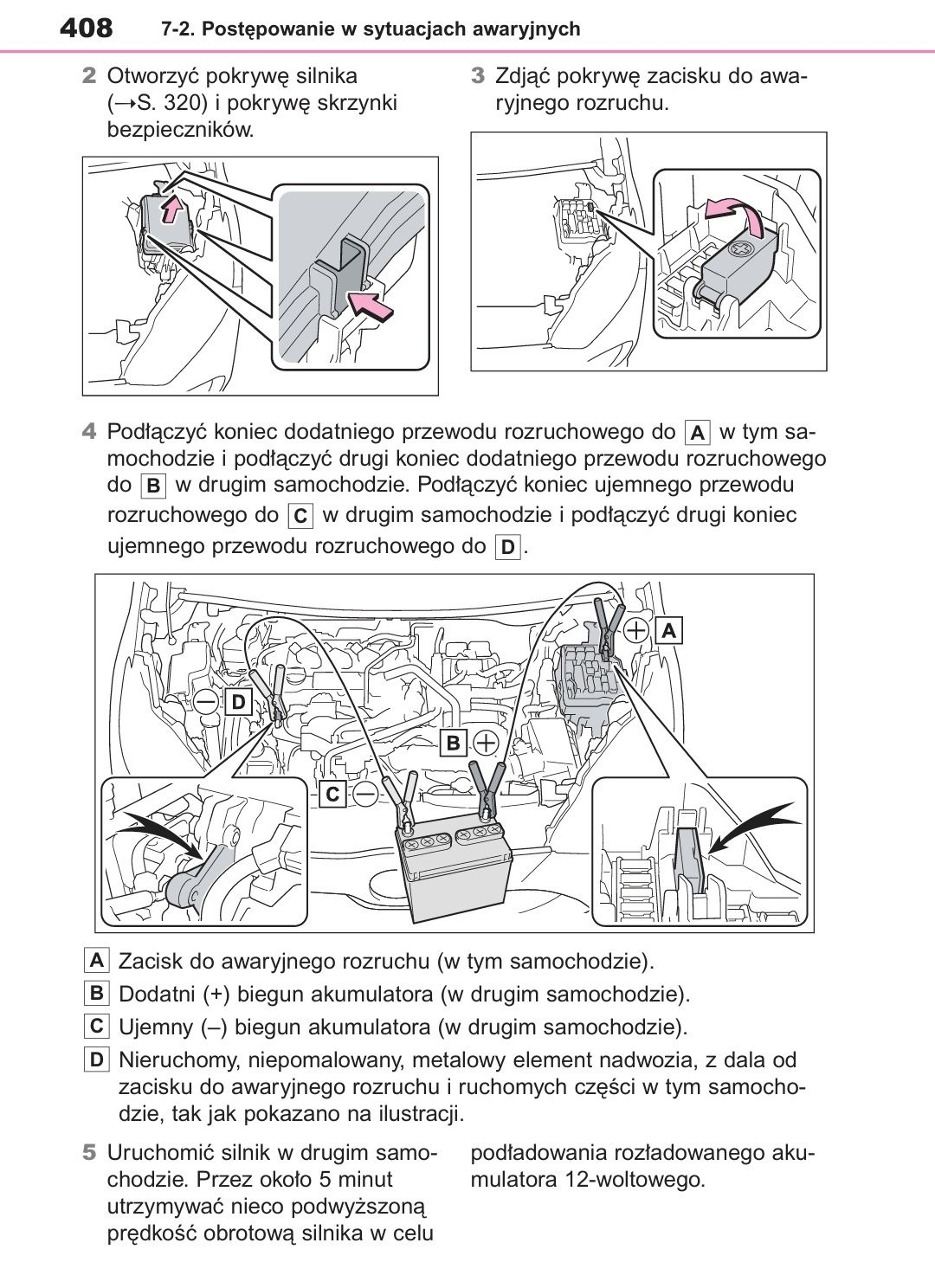
Instead of step 5, of course, we start charging with the charger.
Both chargers above also offer an extra option: installing leads for quick connection through an additional sealed quick connector. The ring terminals are bolted to the battery terminals (under the rear seat) and the lead is routed out wherever is convenient. The charger can then be connected by gently trapping the charging lead in the door seal. This lets you charge the battery with the car closed, without opening the bonnet or removing the battery cover each time.
Parking in a garage or on a closed driveway – no socket
Not everyone has power in their own garage, and not everyone wants to leave a car “on the charger”, for example in a shared underground car park. We can use the charging built into the Yaris and the fact that it charges at full power the whole time the car is switched on and in P.
Get in, switch the car on and wait until it enters Ready mode (shown on the instrument cluster). Leave the car like this for about 30 minutes (for every week parked; that is, if the car isn’t driven for a week, do this charging at least every 7 days). While the car charges, you can listen to music, read a book or watch an episode of a series on a laptop or phone. You can also use the time to tidy or wash the car. To make the combustion engine start less often, switch the lights to sidelights (unfortunately they can’t be turned off completely) and turn off the fan and air conditioning. Keep an eye on the car, though – in Ready mode it is ready to drive, and if you have keyless entry, the key doesn’t need to be inside the car for someone to drive off!
Parking outdoors
Another option is to top up the parked car with a solar panel placed behind the windscreen. Incoming light should generate a small current that tops up the battery. An example panel with suction cups for the inside of the windscreen: Eco-Worthy 10 W.
This panel has a cigarette-lighter plug, which unfortunately can’t be used directly in the Yaris IV – the lighter socket is live only when the car is switched on. We can, however, use an adapter for the OBD2 diagnostic port (powered all the time) and use the panel’s lighter plug that way. An example adapter: lighter socket to OBD2.
Preventing problems before a planned long stay
When we go on holiday or away for work and know the car will stand unused for 2 weeks, it is worth taking preventive steps.
The simplest is to charge the battery fully. We can use a charger or P mode for this (described above).
If we can, we can connect a maintenance charger or a solar panel (also described above).
As a last resort, we can disconnect the car’s power. Fortunately, there’s no need to remove the battery. We can use the DC CUT fuse in the fuse box in the engine bay on the right (looking at the car from the front), i.e. on the driver’s side in a left-hand-drive car:
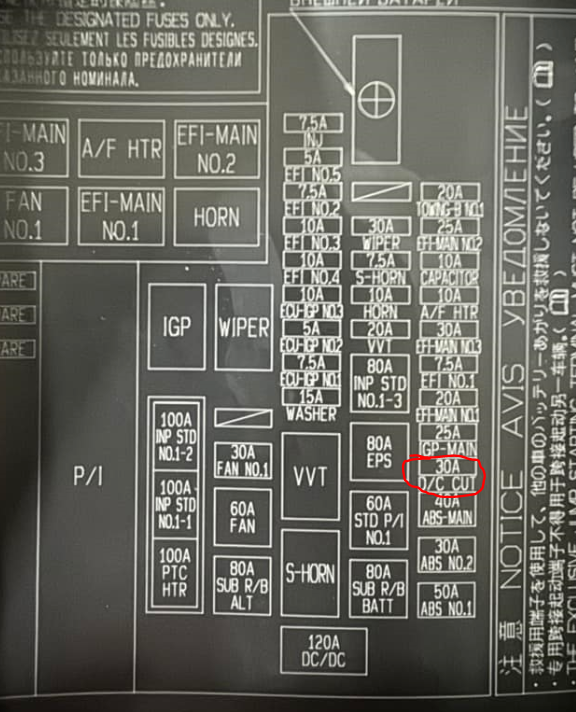
Pulling this fuse cuts power to most systems. We then have to lock the car by hand with the physical key (in cars with keyless entry, the physical key is hidden inside the fob). Lock the car with the central locking beforehand, so that all the doors are locked.
If we don’t want to disconnect the power, we must have a booster ready. Don’t keep it in the boot, though: without power we won’t open the boot and will have to get in by folding down the rear seat.
The car covers longer distances regularly (causes: c, d, f)
If frequent driving gives our Yaris a chance to charge the battery and starting problems still appear, then, unless the battery is faulty, finding the cause can be really hard.
Owners of dashcams with parking mode should start by turning it off. Despite appearances, it can draw a lot of energy. Leaving it on can make the cause harder to find, even if the camera wasn’t the culprit. For the same reason, we disconnect any extra devices we have permanently wired into the 12 V system (animal repellers).
If the car is still under warranty, it is worth passing the problem on to an authorised service centre. You may need evidence such as trip logs from the app (to prove that the problems occur despite regular use of the car). Starting problems or low battery voltage despite regular use qualify the battery for a warranty replacement. Many service centres then don’t make a fuss, and the reluctant ones can be persuaded by escalating to Toyota’s head office – described here.
If the car is out of warranty, you can start by replacing the battery “blind”, especially if it has never been replaced. Recommended LN0-size models (i.e. cars built up to 09/2025):
Since 12 V battery problems are notorious, it is worth measuring the battery’s capacity. The test done at service centres doesn’t check this (!) and its most common verdict is “good – undercharged”. You need to measure the capacity with a charger that can do it. I use an Imax B6 hobby charger myself.
If the capacity is too low, you will need a new battery. If it is roughly right, move on to the next step: finding the component that draws current while the car is parked.
If you don’t have the time, have a workshop do it: they can measure the current draw while disconnecting individual modules to find the cause by elimination.
You can, however, try diagnosing it yourself, even by trial and error. First, rule out potential “power thieves” one by one. These are, for example, an added alarm or anti-theft devices. Deactivate them according to the manufacturer’s instructions. If your car has keyless entry and lets you turn it off, it is also worth deactivating it.
The further steps are more advanced and take more time. I won’t describe them here because they are quite complex.
Video guides
- Replacing the battery (narrated in French)
- How to use a booster (narrated in English)
Facts and myths
- The Toyota Yaris IV uses an AGM or EFB battery
No. The Yaris III used AGM; for the fourth generation Toyota chose a cheaper, conventional lead-acid battery that vents its gases outside the cabin. - To charge the battery, you have to drive the car
The charging voltage (and so the charging rate) is highest when the car is switched on and standing in P (park). - The 12 V battery only charges when the combustion engine is running
No, the 12 V battery is charged from the traction (HV) battery the whole time the car is in Ready mode. - The hybrid Yaris is only for people who drive XXX km a year
No, although those people will potentially see the biggest savings from the hybrid’s lower fuel consumption. For charging the battery, what matters is time, not speed. Anyone who uses the car for at least 1 h each week (e.g. a 10-minute trip on 6 days out of 7, or a one-hour trip once a week) shouldn’t have problems with the battery’s state of charge. This means the battery charges just as effectively standing in a traffic jam as driving on the motorway. - To spare the 12 V battery, turn off the air conditioning
No, the air conditioning in the Yaris IV runs off the HV battery. - Only an added alarm and/or keyless entry are to blame for battery problems
No, although these accessories increase the energy drawn while the car is parked and can make the problem worse. On their own, though, they are not the root cause of 12 V battery problems in the Yaris IV. Installed properly, they draw little current and allow longer stays. - Fitting a higher-capacity battery will damage the car’s electrical systems
Nonsense. Charging is controlled by a circuit that regulates the charging current; a battery can’t be “too big”, even if it had 100 Ah. - Replacing the battery yourself voids the car’s warranty
Replacing it yourself can void the warranty if you do something silly along the way (e.g. connect the battery the wrong way round!) and damage the car’s electrical systems. You also lose any remaining warranty on the battery you removed (which is obvious). However, replacing this part is described in the owner’s manual as a job you can do yourself. There is no obligation to have it done at an authorised service centre or to fit only a Toyota-branded battery. - A hybrid can’t be used to jump-start another car
True, for two reasons. First, the hybrid’s low battery capacity can drain very quickly before the other car’s battery is charged enough to start it. Second, if you connect the other battery while the DC/DC converter that powers our battery is running, the sudden surge of current to the “receiver” can blow a fuse or damage the converter itself, which isn’t designed for such loads. - Just buy a booster and you’re sorted
Yes, but no 🙂 A booster is the car’s equivalent of a defibrillator. Would we accept as normal the condition of a person whose heart stops every few days? A booster is an emergency tool for quickly starting a car with a flat battery. It can help, and it is valuable for people who can’t afford to wait for roadside assistance, but the goal should be to remove the cause, not fight the symptoms. - You can only charge the battery by connecting the charger directly to the battery under the rear seat
No, you can use the jump-start point in the fuse box under the bonnet. It is connected with a thick cable that can carry a large current when a second (donor) battery is connected, so the charger’s current is no problem at all. There are no fuses or relays along the way either. - You have to remove the battery from the car to charge it
It depends. You can do it for safety, but only to prevent a damaged battery catching fire inside the car. A healthy battery can be charged with a charger inside the car. Take care when connecting a simple rectifier charger – its voltage may be higher than a smart charger’s, which can make the battery gas and heat up.