Budding · Taking shape, still changing
Fitting a 55Ah Exide EFB battery in a Yaris IV (the angle-grinder way)
In March 2026 I replaced the 35Ah Toyota-Yuasa battery in my 2023 Yaris Hybrid with a 55Ah Exide EL550 EFB. A battery that size needs the wider LN1 base plate, which older cars don’t have, so I modified a spare one. This is why I did it, how I did it, and what the battery has done since.
Based on my posts on Toyota Owners Club, 17 Feb 2026 – 7 Nov 2026.
Why a bigger battery
The Toyota-Yuasa battery I got under warranty is better in terms of self-destruction when compared with Mutlu. But the real killer is the charging algorithm. My use case is frequent but short journeys, often no longer than 2 miles. Yet the car did almost 13k km = 8k miles since the battery was changed, which equals 535 miles per month on average.
My guess is that the “daily” short journeys have close to zero energy balance, ie. the car hardly replenishes the battery charge used up when it’s parked. So the only way to actually recharge the battery is to do a longer run, which we do, on average, once a week. But because the algorithm stops charging when the battery reaches 80% charge level (or anything close), any longer (like a 1h long) trip doesn’t cause the battery to be recharged for the full hour, but probably for half of that time.
I’m pretty sure that the algorithm will kill any battery of that capacity.
That’s why extra capacity matters. It gives us extra time (it will take longer to deplete the battery to the same level as the smaller OEM one) and allows it to accept more charge in a shorter time. So if I’m right, installing a 50+Ah battery should allow me to use the car the same way I use it currently, and it should withstand much longer.
In short, the higher capacity gives you 2 things:
- Buys you time
- Speeds up charging
- (and potentially better resistance against sulfation when it goes to EFB with carbon tech)
So just these aspects, IMO, make it worth the investment (especially if other methods are unavailable for us, like a hard-wired charger on our driveway).
Why EFB, and not AGM, gel or lithium
My first idea was an AGM battery:
- Battery base swap/customisation to fit LN1
- Installation of an AGM battery like the Yuasa YBX9012
In result one can achieve 50Ah of capacity with a great tolerance of the low voltage conditions.
I changed my mind after more research. I had a discussion with some battery freaks, and the main problem with our cars is not that they cycle (actually they don’t really, as a cycle would be charging to full and then discharging to empty) but that they are constantly in the 40-60% charge range. That’s why I picked EFB over AGM: the AGM would never fully charge and regenerate the capacity. And I’m afraid the same story goes for the gel ones.
A standard liquid acid battery should not be replaced by an AGM battery, because AGM needs a slightly higher voltage to be properly charged, so it will be permanently undercharged, undermining all benefits of AGM tech. Unless your car alternator can provide 14.8V. The Toyota DC/DC converter cannot. A liquid acid battery can however be replaced by an EFB, which is the middle ground between SLA and AGM.
Size is the other constraint. It’s very difficult to find something that will fit 175W x 175L x 190H mm. Also the maximum charging voltage of 14.4V for gel batteries might be exceeded in the Yaris.
My research concluded that the Exide EFB should work very well in the Yaris. The carbon addition on the negative plate should limit the sulfation in low charge scenarios, and EFB tech will allow it to regain charge much faster when compared to a standard battery. And it’s not that much pricier than AGM, which requires a much tighter charging regime.
TBH the ultimate solution would be a LiFePO4 battery with a smart BMS that will accept any voltage coming in (regardless if that’s 12.8V or 14.7V), regulate it to the required level and charge the cells internally. But that’s a lot of risk, and I’m not sure I’d like to take it right now, especially as I didn’t find that kind of integrated BMS in drop-in replacements. Most of them require a stable 14.4V for charging and that’s it.
Is a bigger battery allowed?
The user manual only mentions that:
- The battery must meet the EU norms
- The dimensions have to match the original battery, because it won’t be able to be properly secured otherwise
- It should have no less capacity and CCA than the originally fitted one, otherwise it will discharge too quickly
- It should have a vent and a handle
There are no other constraints, at least not in my manual. There is no maximum capacity requirement. Only the minimum is mentioned, and the minimum is 35Ah. If following the user manual would cause the warranty to be invalidated, boy, that would cost Toyota much. Both in money and PR, if such a situation went public.
Newer cars already have the bigger plate
Toyota introduced a large base plate that fits LN1 size batteries in the late 2025 models (cars made after 10/2025). Cars made in 2026 should carry an OEM 45Ah battery. Still Mutlu, but almost 30% more capacity.
For older cars we now have two alternative methods of retrofitting an LN1 battery: buy the new LN1 tray, or modify the old one as I did.
Modifying the base plate
Inspired by CPN, who swapped his battery tray for the wider LN1 one, I decided to give it a try. I picked the Exide EL550 EFB battery and charged it fully at home, and after another failure to start on the Toyota-Yuasa battery, I decided to change them.
The new tray was the problem. Dealerships in my country couldn’t deliver it soon (their ETA was mid April) and the price for that piece of stamped metal was outrageous (~85 GBP), so I decided to do this the barbaric way, ie. using the angle grinder, like a true Slav would do. I hope my ancestors are proud.
I bought another LN0 base plate for like 9 GBP (free shipping) and cut off the clamp on the HV side.
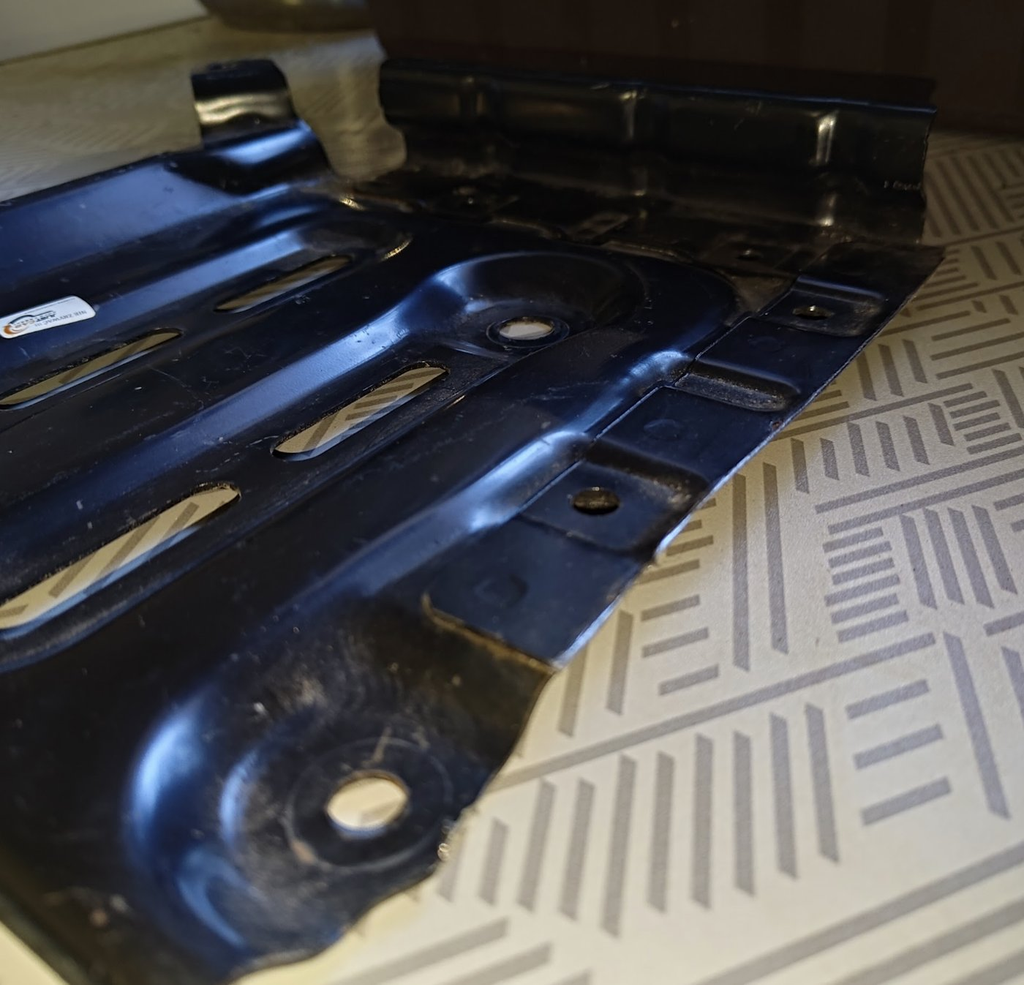
One minute with some sandpaper and we’re good to go.
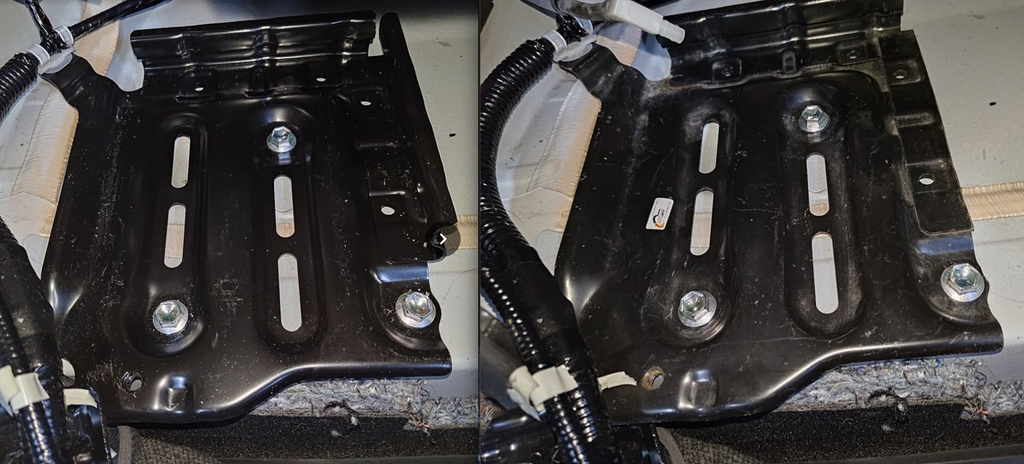
In the car I did the standard disassembly, as shown in every French video of 12V battery replacement, but kept going and unscrewed the base plate. Easy. Then I assembled the modified base plate. Before and after:
Installation of the battery was quite easy, and I think it was easier with the modded base plate, because the lack of this side clamp allowed the battery to be pushed inside with a rotation and be straightened only after I assembled the positive terminal module.
Anyway, it sits well
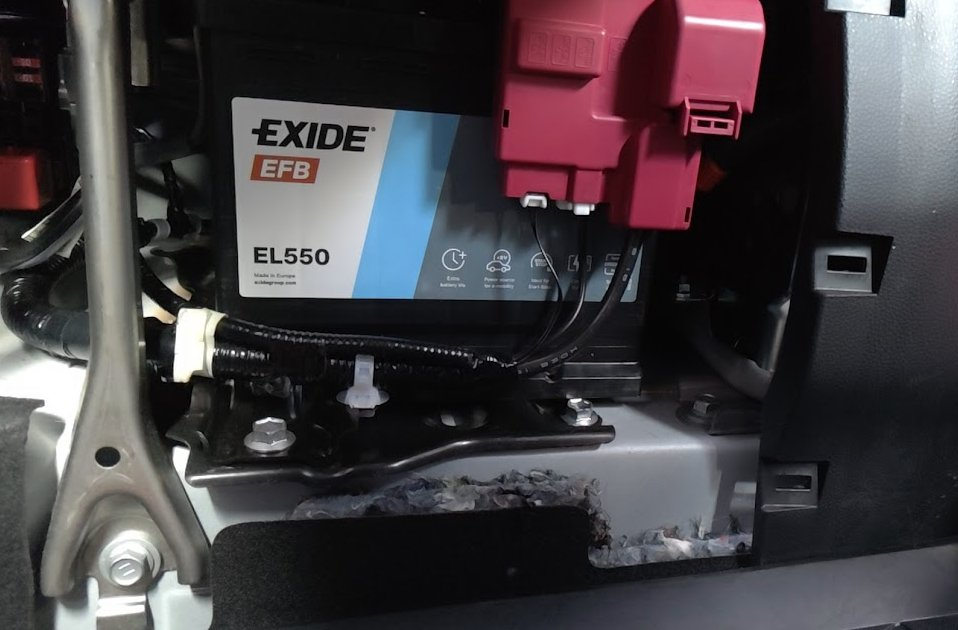
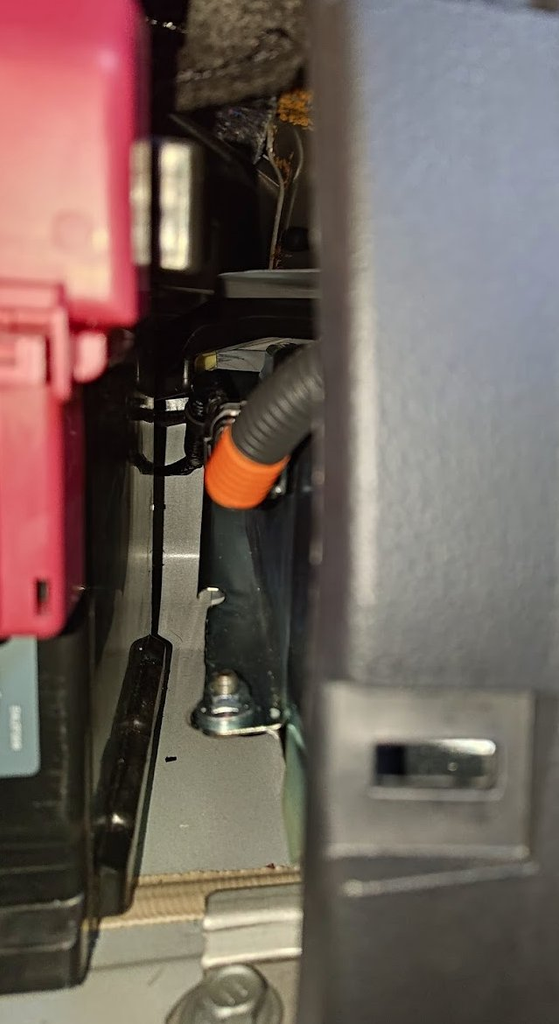
and of course there is some clearance to the HV battery.
Tip: charge a new battery before you fit it. When buying my 55Ah Exide, which was manufactured in January 2026 (so it was just 2 months old), I was still able to push ~5Ah into it. It’s far easier when it’s not in the car yet.
Safety: can the battery move?
I installed the front clamp and did some tests on how easily the battery could be moved. And the concerning part is: it is possible if I push or hit the side wall of the battery towards the middle of the car. So in theory a collision with the HV battery is possible in case of an accident (rollover or side impact).
It should be possible to use a strap (something like a 1m transport belt) around the battery and around the vertical seat support. That’s a sturdy piece of metal and should work fine in this scenario. I left it as-is for now, but will probably put a belt on soon and exchange it for the LN1 plate later.
Results after one month
It’s been exactly a month since I installed the Exide 55Ah battery. I didn’t change the way I use the car. During that time we did 170 mostly short journeys, totalling 576 miles, with an average length of 3.4 miles per journey. Average speed is 18.8 mph, giving a total driving time of 30h 38min.
I measured the voltage today and it’s a stable 12.4V, with a battery temperature of 16 degrees Celsius, meaning around 80% SoC (with some sources claiming 90% SoC), so spot on.
A few weeks later I noticed something interesting. My SO took the Yaris for a quick shopping trip. 2 x 4 minute drive. Less than a mile each way. Yet the battery voltage after 2h of parking was still 0.1V higher than it was before she departed (12.4 → 12.5V). This confirms the theory that EFB is much more capable of storing energy even during very short journeys.
Results after three months
It’s been more than 3 months since I installed the Exide 55Ah battery in my Yaris. For more than 2 months I’ve been collecting data from a voltage logger, so I can present a summary. My driving profile is mainly suburban driving (many short or very short trips) with an occasional longer journey (60 miles total).
| Month | Driving time | Distance | Average speed |
| March | 25 h | 760 km / 475 miles | 30 km/h / 18.8 mph |
| April | 28 h | 840 km / 525 miles | 30 km/h / 18.8 mph |
| May | 21 h | 610 km / 380 miles | 29 km/h / 18 mph |
| June | 22 h | 780 km / 485 miles | 35 km/h / 21.9 mph |
So I think it’s pretty consistent. The 12V battery was never charged since I installed it. I am charging it right now to keep it healthy. I plan to do that every 3 months.
Now, the battery stats:
- Minimum registered voltage: 12.14V, maximum: 14.49V
- All-time average voltage: 12.52V, median: 12.47V
- The longest parking period: 2 days 20 hours
I can see that the averages are higher in cold months, so there must be some temperature compensation when charging.
Conclusion: the Exide EFB battery behaves very well. I can see it keeps the voltage around 12.5V, so around 70-80% SoC. I’m glad I did this mod and skipped the inevitable Yuasa 45Ah episode.